
When people hear the word “veneers,” they often picture overly white, bulky, obviously artificial teeth. But that’s not what modern cosmetic dentistry should look like.
The goal isn’t to create a different smile. It’s to refine the one you already have.
At Hansen Orthodontics & Aesthetics, Dr. Hansen approaches veneers differently. Instead of focusing only on the surface appearance, he evaluates structure, function, muscle balance, and facial harmony before designing anything.
Because truly natural veneers don’t just look right — they move right, rest right, and function right.
Let’s talk about what makes that difference.
Step One: It’s Never “Just Veneers”
Before any cosmetic work begins, Dr. Hansen evaluates the full picture.
That includes:
- Bite alignment
- Jaw position
- Lip support
- Facial proportions
- Muscle activity
- Tongue posture
- Airway considerations
Why?
Because veneers placed on an unstable foundation won’t look natural over time.
In some cases, patients benefit from myofunctional therapy before or alongside cosmetic treatment. When oral muscles function properly, veneers sit in a healthier, more stable environment.
It’s not about doing more treatment — it’s about doing the right treatment first.
The Hidden Role of the Tongue
Most people never think about where their tongue rests.
But it matters more than you’d expect.
Improper tongue posture can influence:
- Tooth positioning
- Pressure against veneers
- Bite stability
- Smile shape over time
That’s why tongue posture therapy may be recommended in select cases before finalizing veneer design.
When the tongue rests gently against the palate instead of pushing against teeth, cosmetic work remains more stable and balanced.
This is one of the subtle details that separates natural results from short-term fixes.
Why Muscle Function Matters in Cosmetic Dentistry
Natural veneers must coexist with facial muscles.
If muscles around the lips and cheeks are hyperactive or imbalanced, they can:
- Create excessive pressure
- Alter smile dynamics
- Affect how much tooth shows
- Change gum display
That’s where muscle function orthodontics plays an important role in treatment planning.
Even when veneers are primarily cosmetic, understanding muscle patterns allows Dr. Hansen to design restorations that harmonize with facial movement instead of fighting against it.
The result? A smile that looks effortless — not stiff or overdesigned.
Orthodontics and Veneers: A Strategic Partnership
Many patients assume veneers can “fix everything.”
But sometimes alignment should come first.
In cases where teeth are crowded, rotated, or unevenly spaced, conservative orthodontics may be recommended prior to cosmetic enhancement.
Understanding the relationship between orthodontics and tongue position helps ensure veneers are placed in a stable, functional arrangement.
This approach allows for:
- Less enamel removal
- More conservative veneer preparation
- Better long-term bite balance
- Reduced stress on restorations
The goal isn’t speed. It’s longevity.
The Power of Subtle Myofunctional Exercises
In certain patients, simple habit changes and guided exercises can dramatically improve cosmetic outcomes.
The myofunctional exercises benefits include:
- Improved lip seal
- Reduced mouth breathing
- Better tongue resting posture
- Enhanced muscle coordination
- More balanced smile dynamics
When muscles function properly, veneers don’t have to compensate for instability.
It’s a quiet but powerful part of the process.
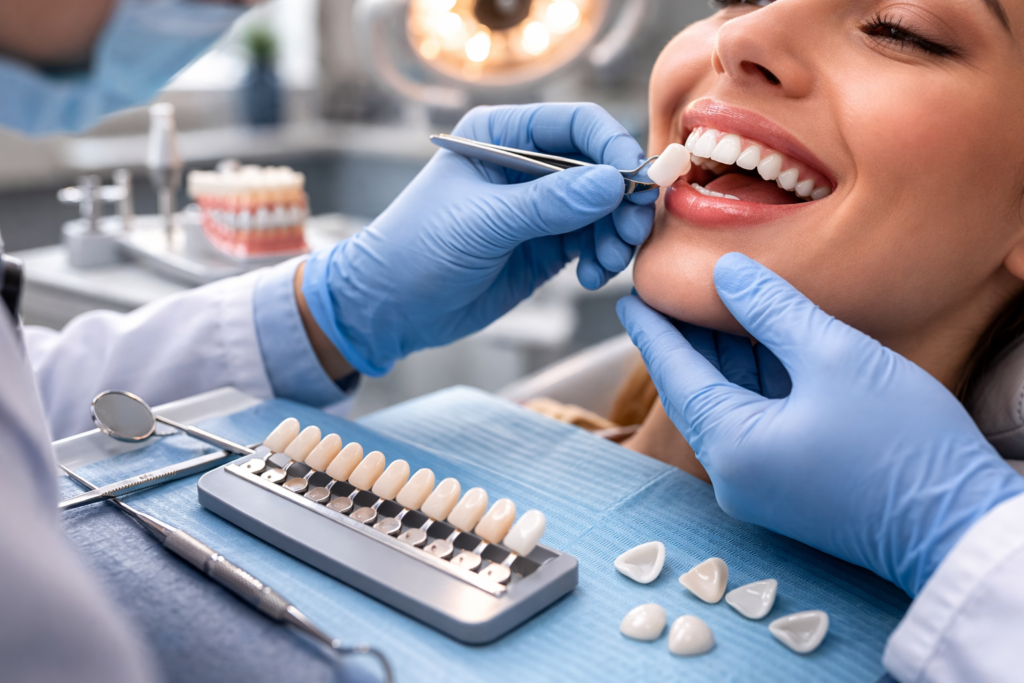
Designing Veneers That Look Like Real Teeth
Now let’s talk about aesthetics.
Natural veneers are about proportion, not perfection.
Dr. Hansen considers:
- Tooth width-to-length ratio
- Incisal edge contour
- Smile arc alignment
- Light reflection
- Surface texture
- Translucency and layering
Teeth are not flat white blocks. Real enamel has depth, subtle color variation, and micro-texture.
That’s why natural veneers require careful collaboration with skilled dental laboratories that understand nuance.
Overly opaque veneers look artificial. Overly bright veneers look disconnected from facial tone.
Balance is everything.
Airway, Muscles, and Cosmetic Stability
Here’s something most cosmetic consultations skip:
Breathing patterns influence facial structure.
Poor oral posture and airway restriction can affect lip positioning, jaw posture, and muscle tension. Over time, this may alter how veneers function.
Maintaining airway and muscle balance ensures cosmetic work supports — rather than disrupts — overall facial harmony.
When breathing is nasal and muscles are coordinated, veneers integrate seamlessly into the system.
It’s not about overcomplicating the process. It’s about respecting biology.
When Orthodontic Support Is Necessary
Sometimes veneers are requested to “hide” alignment issues.
But covering misalignment without correction can create:
- Bulky restorations
- Over-prepared enamel
- Unstable bite forces
- Long-term chipping or wear
In these situations, limited orthodontic treatment support may be recommended first to create ideal spacing and alignment.
This allows veneers to be:
- Thinner
- More natural
- Less invasive
- Longer-lasting
Small corrections upfront often prevent major corrections later.
What Makes Veneers Look Fake?
Let’s be honest — we’ve all seen them.
Common reasons veneers look unnatural include:
- Excessive tooth length
- Uniform color without depth
- Lack of texture
- Ignoring facial proportions
- Ignoring lip dynamics
- Skipping structural evaluation
Natural veneers respect individuality.
They don’t erase character. They refine it.
The Consultation Process at Hansen Orthodontics & Aesthetics
When you visit Dr. Hansen for a veneer consultation, expect a comprehensive evaluation — not a rushed cosmetic pitch.
The process may include:
- Digital smile analysis
- Bite and muscle assessment
- Photographic review
- Discussion of goals and lifestyle
- Review of long-term maintenance
We talk about what you want — but also what will age well.
Because a natural smile today should still look natural ten years from now.
Veneers Aren’t for Everyone — And That’s Okay
Some patients may benefit more from:
- Whitening
- Minor contouring
- Orthodontic alignment
- Bonding
- Habit correction
Veneers are powerful, but they’re not always the first step.
The best cosmetic outcomes come from choosing the least invasive option that achieves the goal.
Why Patients Trust This Approach
Patients appreciate that Dr. Hansen:
- Looks at function before aesthetics
- Preserves enamel whenever possible
- Designs smiles that match facial features
- Integrates orthodontic and muscle considerations
- Focuses on long-term stability
Natural veneers aren’t about trends.
They’re about harmony.
The Result: A Smile That Doesn’t Look “Done”
When veneers are designed properly:
- They blend with facial tone
- They reflect light naturally
- They move comfortably
- They support balanced speech
- They feel like your own teeth
Most importantly — people notice your smile, not your dental work.
And that’s the difference.
Conclusion
Creating natural veneers requires more than cosmetic skill — it requires understanding structure, muscle function, and long-term balance. By evaluating the full picture before designing restorations, Dr. Hansen ensures that each smile enhancement feels authentic, stable, and uniquely personal. True cosmetic dentistry doesn’t transform who you are — it refines what’s already there in a way that looks effortless and lasts for years to come.