
When most people think about braces, they think about straight teeth. But what if orthodontics could also support better breathing? What if your child’s bite, jaw growth, and even sleep quality were connected?
That’s where airway-focused orthodontics enters the conversation.
In recent years, more specialists have begun evaluating not just alignment, but also how jaw structure, tongue position, and facial development influence airflow. The goal isn’t just aesthetics — it’s function.
At Hansen Orthodontics & Aesthetics, this broader perspective helps families understand that orthodontic treatment can sometimes play a supportive role in breathing and sleep health.
Let’s unpack what that really means.
What Is Airway Orthodontics?
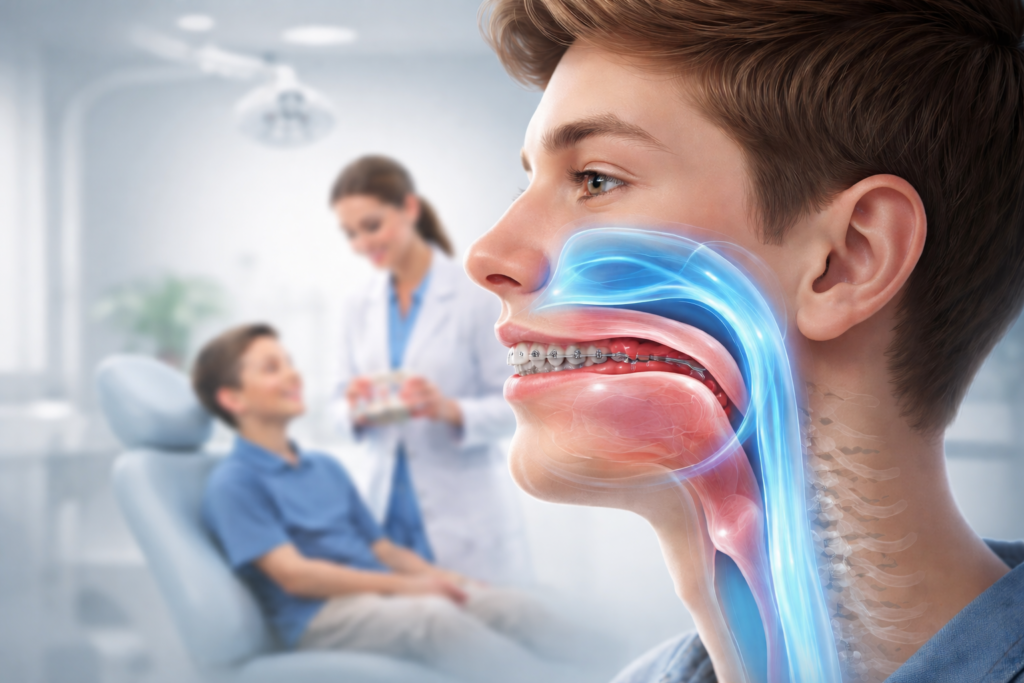
Airway orthodontics is an approach that evaluates how dental and skeletal development affects the space behind the nose and mouth — the airway.
Instead of focusing only on straightening teeth, this philosophy considers:
- Jaw positioning
- Facial growth patterns
- Tongue posture
- Nasal breathing
- Bite relationships
- Sleep-related concerns
When the upper or lower jaw is underdeveloped or positioned incorrectly, it can reduce the space available for airflow — especially at night.
This doesn’t mean orthodontics replaces medical sleep treatment. But in some cases, structural alignment can support healthier breathing patterns.
How Are the Jaw and Airway Connected?
Think of the jaws as the frame that holds the airway open.
If the upper jaw is too narrow or the lower jaw sits too far back, it may reduce the space where air passes through. Over time, this can contribute to:
- Mouth breathing
- Snoring
- Restless sleep
- Daytime fatigue
- Poor concentration
In growing patients, guiding development early can sometimes make a meaningful difference.
That’s why airway discussions often overlap with orthodontics for teens — because adolescence is still a window of growth.
Why the Teen Years Matter So Much
The teenage years are critical for facial development. The bones are still maturing, and orthodontists can guide growth patterns more effectively than in adulthood.
When airway concerns are identified early, treatment may focus on:
- Expanding narrow arches
- Encouraging forward jaw positioning
- Improving bite balance
- Supporting nasal breathing habits
This doesn’t mean every teen needs airway intervention. But evaluation during growth provides options that may not exist later.
That’s one reason comprehensive orthodontic care for teens includes more than just checking if teeth are crooked.
Can Braces Improve Breathing?
Braces themselves don’t “treat” sleep disorders. But they can correct structural issues that influence airflow.
Modern braces options allow orthodontists to move teeth and guide jaw positioning in a way that supports both function and aesthetics.
For example:
- Expanding a narrow upper arch may create more tongue space
- Correcting a deep overbite can reduce jaw retrusion
- Aligning teeth can improve oral posture
In certain cases, these changes may contribute to improved airflow dynamics — especially when combined with medical evaluation.
What About Clear Aligners for Teens?
Parents often ask whether clear aligners for teens can support airway-focused care.
The answer depends on the case.
Aligners are excellent for:
- Mild to moderate alignment issues
- Cosmetic straightening
- Responsible teens who follow wear guidelines
However, when growth modification or skeletal expansion is required, traditional appliances may offer more control.
Every teen’s anatomy is different. That’s why customization matters.
Are Braces for Adolescents Sometimes Better?
In some airway-related cases, braces for adolescents may provide more consistent force application and better control over complex movements.
Especially when addressing:
- Bite discrepancies
- Vertical jaw relationships
- Significant crowding
- Growth guidance needs
Because braces work continuously (unlike removable appliances), they can sometimes deliver more predictable structural results.
Again, it’s not about which appliance is “better” — it’s about which is appropriate for the specific goal.
How Do You Know If Airway Concerns Exist?
Many parents don’t immediately connect breathing and orthodontics.
But signs that may prompt further evaluation include:
- Chronic mouth breathing
- Snoring in children
- Difficulty staying asleep
- Frequent dry mouth
- Forward head posture
- Dark circles under the eyes
- Narrow smile appearance
If these symptoms are present, a collaborative approach between orthodontist, pediatrician, and sometimes an ENT specialist may be recommended.
Airway orthodontics works best as part of a team effort.
Beyond Breathing: The Bigger Picture
Even when sleep improvement isn’t the primary goal, airway evaluation often leads to better structural balance.
And that impacts more than airflow.
Balanced development supports:
- Improved chewing efficiency
- Reduced jaw tension
- Better tongue posture
- Long-term bite stability
- Enhanced facial harmony
Which brings us to another important point: aesthetics and function are not separate.
Proper structure often results in natural smile correction without overcompensation.
What Happens During an Airway-Focused Evaluation?
At Hansen Orthodontics & Aesthetics, an airway-conscious consultation may include:
- Digital imaging
- Bite analysis
- Facial profile assessment
- Arch width measurements
- Growth pattern evaluation
- Discussion of sleep habits
We’re not diagnosing sleep disorders — but we are identifying structural patterns that could influence breathing.
From there, we discuss options clearly and honestly.
No overpromising. No unnecessary treatment.
Can Adults Benefit Too?
Yes — but differently.
In adults, skeletal growth is complete. That means expansion and jaw repositioning options are more limited.
However, orthodontics can still:
- Improve tongue space
- Optimize bite relationships
- Reduce dental crowding
- Support overall comfort
In some adult cases, orthodontics may be part of a larger treatment plan involving medical sleep specialists.
Is Airway Orthodontics Right for Everyone?
Not necessarily.
Some patients simply want alignment and cosmetic improvement. And that’s perfectly valid.
Airway-focused care is most relevant when:
- There are visible structural imbalances
- Sleep concerns are present
- Facial growth patterns suggest airway limitation
- Parents want a comprehensive developmental approach
The key is evaluation — not assumption.
Why Families Appreciate This Approach
Parents today are more informed than ever. They’re not just asking, “Are my child’s teeth straight?”
They’re asking, “Is everything developing properly?”
Families appreciate that we:
- Look beyond surface alignment
- Consider long-term growth
- Personalize every treatment plan
- Educate without overwhelming
- Prioritize both health and aesthetics
Because orthodontics isn’t just cosmetic. It’s structural.
What Should You Do Next?
If your teen snores, mouth breathes, or struggles with restless sleep — or if you simply want a comprehensive evaluation — scheduling a consultation is the first step.
Even if airway treatment isn’t necessary, you’ll gain clarity.
And clarity gives you confidence.
Conclusion
Airway orthodontics is about understanding the connection between jaw development, breathing, and long-term function. While it doesn’t replace medical treatment for sleep conditions, it can play a supportive role in creating better structural balance. For growing teens especially, early evaluation opens the door to proactive, personalized care that benefits both health and confidence. When orthodontics considers the whole picture, the results go far beyond straight teeth.