
If you’ve ever looked closely at your smile and thought, “My teeth are straight, but something still feels slightly uneven,” you’re not imagining it.
Sometimes, the issue isn’t alignment — it’s shape.
That’s where tooth contouring comes in.
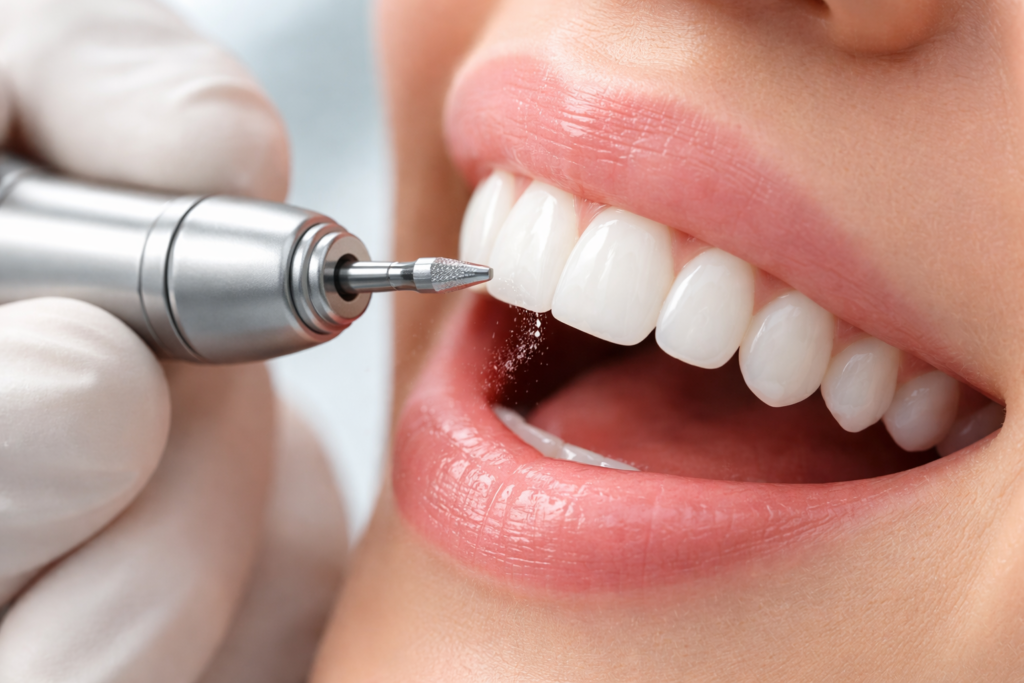
Tooth contouring (also called enamel reshaping) is a conservative cosmetic procedure designed to subtly refine the edges, length, or surface of teeth. It’s quick, minimally invasive, and in the right cases, surprisingly transformative.
At Hansen Orthodontics & Aesthetics, we often explain to patients that a beautiful smile is not just about alignment. It’s about proportion, symmetry, and balance. Tooth contouring can be the final polish that elevates everything.
Let’s break it down.
What Exactly Is Tooth Contouring?
Tooth contouring is a cosmetic dental procedure where small amounts of enamel are carefully reshaped to improve the appearance of a tooth.
It can:
- Smooth minor chips
- Adjust slightly uneven edges
- Refine tooth length
- Improve symmetry
- Correct subtle shape irregularities
The key word here is subtle.
This is not a dramatic structural change. It’s more like sculpting — gently refining what’s already there.
And because enamel doesn’t regenerate, precision and planning are essential.
Is Tooth Contouring the Same as Teeth Straightening?
No — and this is where many people get confused.
If teeth are misaligned, crowded, or rotated, reshaping alone will not solve the problem. That’s when orthodontic treatment becomes the foundation.
Alignment creates the structure. Contouring enhances the aesthetics.
For example:
- Crooked teeth need repositioning
- Gaps need space management
- Bite issues need correction
- Shape irregularities need refinement
In many cases, contouring is performed after alignment is complete — like the finishing touch that perfects the smile.
Who Is a Good Candidate?
Tooth contouring works best for people who:
- Have minor cosmetic imperfections
- Already have relatively straight teeth
- Completed orthodontic care
- Want subtle improvements
- Have healthy enamel thickness
It is not ideal for:
- Severely misaligned teeth
- Large chips or fractures
- Deep structural damage
- Thin enamel
That’s why evaluation matters. The procedure is small, but the planning behind it is thoughtful.
How Does the Procedure Work?
The appointment itself is usually simple and comfortable.
Here’s what typically happens:
- The tooth surface is examined carefully
- Measurements are taken to maintain symmetry
- A fine polishing instrument gently removes minimal enamel
- The edges are smoothed and polished
There’s no anesthesia required in most cases because enamel doesn’t contain nerves.
Patients are often surprised at how quick it is.
Sometimes it takes less than 30 minutes.
Can Tooth Contouring Be Combined with Aligners?
Absolutely — and this is where modern dentistry becomes exciting.
Many patients who use aligners El Paso providers offer, choose contouring as a final step once their teeth are aligned. It enhances the overall cosmetic outcome after movement is complete.
Think of it like tailoring a suit after it fits perfectly.
Clear aligners reposition the teeth. Contouring refines the silhouette.
For adults especially, this combination is incredibly popular.
Why Adults Love This Option
There’s a growing demand for subtle cosmetic upgrades among adults who want natural-looking improvements.
Many patients using aligners adults often ask about small finishing touches once their smile is straight. They don’t want dramatic veneers — just a refined, polished look.
Tooth contouring offers:
- Immediate results
- No recovery time
- No injections in most cases
- No artificial materials added
- A very natural appearance
For adults who prefer conservative treatments, this is appealing.
What About Professionals?
In today’s world, appearance and confidence often intersect with career.
Patients exploring aligners for professionals frequently mention they want a smile that feels polished but authentic. Contouring can help achieve that balance.
It’s especially beneficial for:
- Public speakers
- Sales professionals
- Attorneys
- Executives
- Medical providers
The improvement is subtle — but noticeable in photos and face-to-face interactions.
Is Tooth Contouring Permanent?
Yes.
Because enamel is gently removed, the change is permanent.
That’s why:
- Proper diagnosis is essential
- Over-contouring must be avoided
- Bite alignment must be stable first
When performed correctly, results last indefinitely.
How Does It Compare to Other Removable Orthodontic Options?
Tooth contouring doesn’t move teeth. It reshapes them.
Patients sometimes ask whether it can replace removable orthodontic options — but the answer depends on the concern.
If the issue is:
- Crooked teeth → movement is needed
- Overlapping edges → movement is needed
- Small shape irregularity → contouring may work
In some orthodontic cases, very slight enamel reduction (called interproximal reduction) is also used strategically during alignment to create space — but that’s different from cosmetic contouring.
Each tool serves a different purpose.
Does It Hurt?
No.
Most patients feel:
- Mild vibration
- Light polishing sensation
- No discomfort
There is typically no downtime, and you can eat normally afterward.
Some patients experience temporary sensitivity, but this is rare when enamel thickness is sufficient.
How Do You Know If You Need Alignment First?
This is one of the most important questions.
If teeth are even slightly rotated, overlapping, or unevenly positioned, contouring alone may create imbalance.
That’s where comprehensive teeth straightening planning becomes essential.
Proper alignment ensures:
- Even edge height
- Balanced smile arc
- Correct bite force distribution
- Long-term stability
Without that foundation, reshaping could actually highlight asymmetries.
The Role of Modern Orthodontics in Cosmetic Finishing
The beauty of today’s dentistry is integration.
We no longer separate function and aesthetics. With modern orthodontic solutions, we design smiles holistically.
That means considering:
- Tooth shape
- Tooth position
- Lip dynamics
- Facial balance
- Bite stability
Contouring becomes one small — but powerful — part of a comprehensive plan.
When Is Contouring Not Enough?
Sometimes patients hope contouring can fix:
- Large gaps
- Severe crowding
- Bite discrepancies
- Significant height differences
In those cases, alignment must come first.
And occasionally, restorative dentistry (like bonding or veneers) may be more appropriate.
The goal is always to recommend the least invasive option that achieves the desired outcome.
Why Patients Appreciate This Approach
At Hansen Orthodontics & Aesthetics, patients value that we:
- Don’t oversell cosmetic procedures
- Evaluate structure before aesthetics
- Combine alignment with finishing details
- Prioritize long-term health
- Customize every plan
Because a confident smile isn’t about perfection — it’s about harmony.
What Makes a Smile Look “Finished”?
It’s usually not one dramatic change.
It’s small refinements:
- Symmetrical central edges
- Even incisal line
- Smooth contours
- Balanced proportions
- Consistent tooth length
When those details align, the smile looks effortless.
And most people can’t explain why — they just notice it looks great.
Conclusion
Tooth contouring is a simple, conservative way to refine your smile when alignment is already in place. It doesn’t replace orthodontic care, but it can enhance the final result beautifully. If you’ve been feeling like your smile is “almost there” but not quite, a professional evaluation can help determine whether subtle reshaping is the right finishing touch. Sometimes, the smallest adjustments make the biggest difference.